Introduction: For some time now, processed red meat, has also been linked to many negative health effects. These have ranged from from heart attacks to cancer. But is it all hype or is there some truth to the information. And if there is some truth, what’s the truth?
This is the second part of a series about red meat and the health challenges associated with its consumption. The first part involved the role played by myoglobin in unprocessed red meat. Here we look at the role processing plays in red meat and its consequences.
What is processed red meat?
Processed red meat is any type of red meat that has undergone some method of preservation. The reason for preservation is to increase the shelf life of the meat, in other words, to prevent spoilage. However, most often, there is a secondary purpose which is to enhance the flavor or digestibility of the meat. For red meat, the most common methods of preservation have been smoking, curing, salting and/or the addition of chemical preservatives.
Examples of Processed red meat
Hot dogs, Deli meats (ham, roast beef, turkey) , Bacon, Sausages Pepperoni, Salami and Canned meats(corned beef and spam) are all called processed meats.
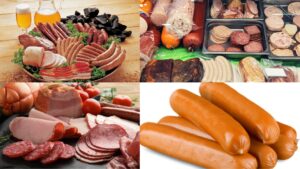
Fig. 1: Examples of Processed Meats
So the question is what changes do processing make to the meat?
Smoking: The method of smoking red meat often involves exposing the meat to both heat and the effects of smoke. During this process, fluids and fat drip from the meat on to the heat surface, and these form unhealthy compounds. These compounds which are then carried to the surface of the meat contaminate the meat. The compounds formed are mostly heterocyclic amines (HCAs) and polycyclic aromatic hydrocarbons (PAHs).
The National Institute of Cancer has issued warnings to the effect that HCAs and PAHs are mutagenic, meaning that they can cause changes to your DNA, which can lead to cancer. High exposure to these compounds (including inhaling the smoke) has been linked to increased risk of intestinal cancer, colon cancer and stomach cancer. It doesn’t stop there. Recent studies suggest that consumption of processed red meats may increase breast cancer and prostate cancer.
What about liquid smoke: Liquid smoke is an ingredient that provides a familiar smoky flavor to foods like meat and fish and poultry without having to do any smoking. It does not require fire and /or standing by a fire at all. However liquid smoking is not without its attendant evils. Though compositions vary, it is generally accepted that liquid smoke contains:
Water (11-92%,
Tar (1-17%),
Acids (2.8-9.5%),
Phenolic derivatives 0.2-2.9% and other
Carbonyl containing compounds (2.6—4.6%).
And Yes, liquid smoke contains some amount (though less than smoked meats) of PAHs which are considered carcinogenic as well.
Curing: Is a process of curing meat that involves adding common salt, nitrates or nitrates to the meat. During digestion of cured meats, and also during exposure to high heat, nitrates and nitrites tend to form N-nitroso compounds which are carcinogenic.
Salting: When common salt (sodium chloride) is used as the major commodity in preserving meat, the process is called meat salting. In this case, excessive salt is used, and it becomes the main preservative. However, over-consumption of salt or sodium has attendant health issues of high blood pressure, heart disease and kidney problems.
Chemical preservatives: This involves the addition of chemical preservatives to the food to inhibit spoilage by microorganisms notably bacteria. Chemical preservatives which are often used include nitrites, nitrates, benzoic acid, potassium sorbates, sulfur dioxide and sulfites. Others are formaldehyde, calcium propionate, tocopherols and Butylated hydroxy anisole (BHA).
Some of these chemical compounds are antimicrobial agents; others are antioxidants. emulsifiers and pH adjusters.
Regulated by Law: The use chemical additives are usually regulated by (US) Federal guidelines or by law in most countries. It seems that by far the chemical compounds of concern happen to be nitrites and nitrates. However, these compounds play a vital role in inhibiting the growth of the deadly spore forming bacteria, Clostridium botulinum, which if allowed to grow, produces botulism, a very fatal poison. That is why it is difficult, if not impossible, to bypass the use of nitrates and nitrites in safe meat preservation for they play a crucial role.
Non-cured or Uncured meats: Although some meat may be labelled as uncured or non-cured, they may still contain some preservatives like nitrates and nitrites. As we have said before, the use of nitrate and nitrites is for a special reason: to inhibit the growth of Clostridium botulinum, a spore-forming bacterium that is heat resistant in its spore form and can produce highly deadly toxins in food products, especially meat that is left improperly treated. .
So how much of the consumption of HCAs and PAHs is safe?
There are no (US) Federal guidelines concerning the quantity of PAH,s and HCAs that are believed safe to eat. However, due to the mutagenic effects of these compounds, the American Cancer society has issued a warning that processed meats should be rarely eaten, if at all
And what chemical products are of concern in processed red meats?
Generally, we can cite 3 of them:
1. Nitrates and Nitrites: These are often used as preservatives in processed meats and can convert N-nitroso-compounds which are carcinogenic.
2. Heme-iron: Heme iron is a component of myoglobin which is found in substantial quantities in red meat. It can be converted to N-nitroso compounds during digestion in the human gut, potentially damaging the lining of the stomach bowel.
3. Heterocyclic Amines (HCAs) and Polycyclic Aromatic Hydrocarbons (PAHs): These mutagenic compounds are formed during the process of high-temperature cooking using meat processing methods like frying, smoking, grilling and frying.
And what are the specific Health Risks associated with the consumption of processed red meat?
Let us discuss five of them here:
1. Heart health issues: Processed meats are often high in saturated fat and sodium. Elevated levels of these in the body contribute to high blood pressure and increased risk of heart disease.
2. Cancer: Many research studies have linked processed meat consumption to a higher risk of coleo-rectal cancer and possibly other cancers like stomach and breast cancer.
3. Type 2 Diabetes: Some research studies suggest a link between red meat and processed meat consumption to an increased risk of type 2 diabetes.
4. Overweight, Obesity and Metabolic issues: Processed red meat consumption may be associated with improper body metabolism and increased abdominal fat levels. These may lead to overweight and obesity.
5. Additional health issues: Processed meat consumption has also been linked to an increased risk of pneumonia, diverticular disease, and colon polyps.
FINALLY WHAT PRECAUTIONS ARE SUGGESTED FOR EATING PROCESSED MEATS ?
Let’s look at 5 of them here:
1. Using hardwood for smoking meats: Most softwoods contain terpenes (resins) which tend to burn quickly, making it difficult to maintain the steady low temperature needed for slow, healthy cooking. Additionally, softwoods tend to produce an unpleasant thick, harsh, pungent acrid smoke that negatively affects the flavor and aroma profile of the meat, even give it a bitter taste. The opposite appears to be the case for hardwoods. Thus its preference as fuel choice for smoking meats.
2. Some people may want to leave red meat alone Smoked turkey and chicken appear to be healthier choices than red meat. Choosing smoked white meat like smoked turkey and smoked chicken may be healthier choices.
3. A combination of liquid smoke and slight smoking may be a healthier choice.
4. Choosing lean cuts: Should you decide to choose beef, for your barbecues, it may be better to choose lean cuts like flank, round, sirloin and tenderloin. And should you decide to choose ground beef, it is better to request beef that is 90% lean. Alternatively, lean cut pork, pork tenderloin and pork loin may have less fat.
5. Avoidance of charring or burning. And meat that is charred or over-cooked could be avoided.
CONCLUSION:
As adult health concerns grow more complex, informed nutritional choices become the key to vitality, longevity, and joy. Let food be your strategy, not your struggle.