UNDERSTANDING WHY YOUR VISION IS FUZZY
Hello, everyone! Have you ever found yourself squinting to read a street sign, or holding a book at arm’s length to see the words clearly? If so, you’re not alone. These common experiences are often a sign of a refractive error.
A refractive error is a widespread eye condition that affects millions of people. Think of your eye as a camera: a perfectly focused camera creates a crisp image, but if the lens is out of whack, the photo comes out blurry.
Similarly, a refractive error means your eye isn’t bending light correctly. And this is what leads to blurred vision.
So what is the good news? The good news is that this is not a disease, and it’s almost always easily corrected.
Therefore, today, we’re going to demystify the four most common types of refractive errors. These are :
Number 1: myopia which is also called nearsightedness,
Number 2: hyperopia, which is also called farsightedness,
Number 3: astigmatism which create blurred vision both at far and near and
Number 4: presbyopia also sometimes referred to as “old eyes”.
. We’ll talk about what causes them, how they affect your daily life. Most importantly, we shall show how a quick visit to an eye doctor can bring your world back into sharp focus.
The Basics of Blurry Vision: How Your Eye Sees
Before we dive into the specific conditions, let’s briefly touch on how your eye works. When you look at an object, light rays from that object enter your eye through the cornea, the clear, dome-shaped front surface.
.
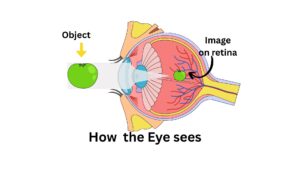
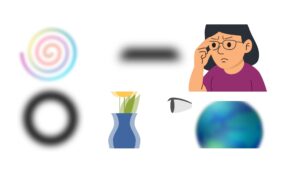
Fig 1: Normal Vision Object focused on retina Fig 2: Blurry vision. Improper focus
The light then passes through the pupil and the lens. The cornea and lens work together to refract or bend the light, focusing it onto the retina at the back of the eye. The retina, which is lined with light-sensitive cells, converts the light into electrical signals. These signals are sent to the brain via the optic nerve, and your brain translates them into the images you see (Fig. 1).
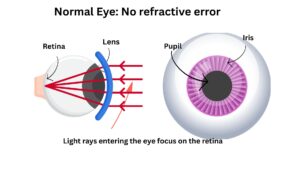
A refractive error occurs when this process goes wrong. Instead of light focusing directly on the retina, it focuses either in front of or behind it, resulting in a blurry image (Fig 2)
This can happen for a few reasons, primarily if the shape of your eyeball is too long or too short, or if the cornea or lens has an irregular curvature.
Myopia: The World Up Close and Personal
Myopia, is commonly known as nearsightedness. It is one of the most common vision problems worldwide. If you’re myopic, you can see things clearly up close, but objects at a distance appear blurry and out of focus. Imagine trying to read a chalkboard from the back of a classroom, or not being able to recognize a friend until they are a few feet away. That is myopia. The eye is made to see at near; that is why myopia is called Near-sighted-ness
So our next question is what causes nearsightedness or myopia?
Myopia usually occurs when the eyeball is too long; that is to say, longer than the average eyeball from front to back. Because of this elongated shape, light entering the eye focuses in front of the retina instead of on it.
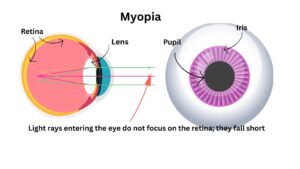
Myopia can also happen if the cornea is too curved for the length of the eyeball. This condition often begins in childhood and can worsen during the teenage years as the body grows. It tends to stabilize in early adulthood.
And How does myopia affect daily life?
For people with myopia, daily tasks like driving, watching a movie, or playing sports can be a challenge. Reading street signs becomes a guessing game. And also navigating a large, unfamiliar space can be difficult.
Children with uncorrected myopia may struggle in school, unable to see the board or a class presentation clearly. Fortunately, this condition is very easy to correct.
Next on the list is Hyperopia: The Farsighted View ?
Hyperopia, or farsightedness, is the opposite of myopia. People with hyperopia can see things clearly at a distance, but objects up close appear blurry. For example, you might be able to see a bird on a distant branch, but you may have trouble reading the text on your phone. So because the eye sees things far off very well, we say the eye is made to see far better …farsightedness.
So, let’s ask the same question again: What causes farsightedness.
Hyperopia is typically caused by an eyeball that is too short. This shorter length means that light rays entering the eye focus behind the retina instead of directly on it. In some cases, it can also be due to a cornea or lens that is too flat. Unlike myopia, many children are born with a slight degree of hyperopia, and their eyes often correct this on their own as they grow. However, significant hyperopia can persist.
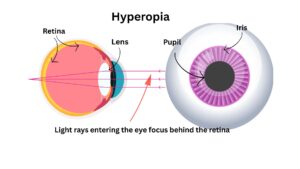
So, How does hyperopia affect daily life?
If you have hyperopia, you may find yourself constantly straining your eyes to focus on nearby objects. Some people may notice that you are squeezing your face at all times and may even think that you don;t like them. This can lead to frequent headaches and eye fatigue.
More importantly, it becomes difficulty with tasks like reading, writing, or using a computer. You might find yourself holding books and magazines at a distance to make the words clearer. A child with hyperopia would not like to read because the vision becomes blurry, and he or she would need to strain the eyes every time thre is the need to read.
The third refractive error we will talk about is Astigmatism. Astigmatism makes the world becomes warped to the viewer.
Astigmatism is a bit different from myopia and hyperopia. While those conditions are related to the length of the eyeball, astigmatism is about the shape of the cornea.
So What causes it?
A healthy cornea has a perfectly spherical, smooth curvature, like a basketball. Light enters and bends evenly, focusing perfectly on the retina. However, with astigmatism, the cornea has an irregular, non-symmetrical shape, more like a rugby ball or the back of a spoon.
This irregular shape causes light to bend unevenly, focusing on multiple points on the retina. As a result, objects appear distorted or stretched out, whether they are close up or far away.
The image might look blurry, wavy, or shadowy, with both horizontal and vertical lines appearing fuzzy.
And How does astigmatism affect daily life?
Astigmatism can cause general blurred vision at all distances. This can be especially frustrating for tasks that require precision, like driving at night, when oncoming headlights can appear streaky or have halos. It can also lead to eye strain, fatigue, and headaches from the constant effort o straining to focus. Many people have a combination of astigmatism and either myopia or hyperopia.
The fourth and last refractive error we shall discuss is Presbyopia
Unlike the other three conditions, which are primarily related to the shape of the eye, presbyopia is an age-related issue that affects everyone, starting in your 40s. It’s often mistakenly called “farsightedness,” but it’s a completely different problem.
So What causes it?
Remember that your eye’s lens and cornea work together to focus light? The lens, unlike the cornea, is flexible. In your younger years, the lens is soft and elastic, and tiny muscles around it can easily change its shape to help you focus on objects at different distances. This ability is called accommodation.
As you age, the lens naturally hardens and becomes less flexible. The muscles also lose some of their power. This makes it increasingly difficult for your eye to change focus from distant objects to close ones.
And How does it affect daily life?
Presbyopia is the reason why people over 40 start holding menus, books, and phones farther away to read them. . The close-up work that was once easy becomes a strain. You might find yourself needing more light to read. You might also experience eye fatigue after reading for a short period of time. This is a natural part of the aging process, not a disease.
The important question is : How do we resolve these issues?
And the answer is that the fact that the world appears to be in a blur doesn’t have to be your reality. Refractive errors are one of the most common and easily corrected health issues. You don’t have to live with the frustration of blurry vision, headaches, and eye strain.
The solution is simple: visit an eye care professional. An ophthalmologist or an optometrist has the tools and expertise to accurately diagnose your specific refractive error. They will perform a comprehensive eye exam, including a simple test called a refraction. During this test, you’ll look through a series of different lenses, and your doctor will ask you, “Which one looks clearer? Number one or number two?” This helps them determine the exact prescription needed to correct your vision.
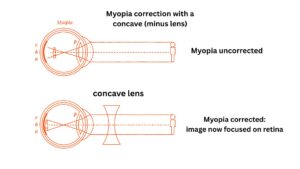
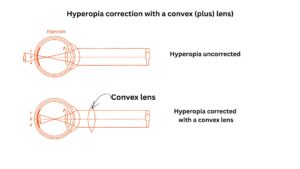
Once your prescription is determined, there are several effective and convenient ways to correct your vision. There are 3 main solutions:
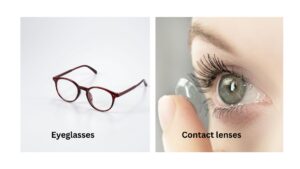
- Number 1: Eyeglasses: This is the most common and straightforward solution. Eyeglasses have lenses shaped specifically to bend light and refocus it correctly on your retina. For example, a concave lens is used for myopia, and a convex lens is used for hyperopia.
- Number 2: Contact Lenses: For those who prefer a more discreet option, contact lenses are a great choice. These tiny, corrective lenses are worn directly on the surface of the eye. They come in a variety of types to correct all four of the conditions we’ve discussed.
- Number 3: Refractive Surgery: For a more permanent solution, eye doctors use procedures that involve the use of a laser to reshape the cornea. This changes how light enters the eye. The procedures help light entering the eye to focus directly on the retina, potentially eliminating the need for glasses or contact lenses.
In conclusion, blurry vision from refractive errors is not a life sentence. It’s a common, treatable condition that can be easily diagnosed and corrected.
Don’t let your world stay in a blur. Take the first step toward clear vision by scheduling an appointment with an eye doctor. You’ll be amazed at how much clearer and more vibrant the world can be. Thank you for being with us.